
From the Aspen Ideas Festival, held recently in Aspen, Colorado, comes this session panel discussion with NEA Chairman Rocco Landesman, the Knight Foundation's Dennis Scholl, and the Ford Foundation's Darren Walker with facilitator Richard Florida. The 50-minute discussion titled “Making Cities Sing” focuses on urban development and the arts, the creative economy and placemaking. Video of the full discussion is now available.
Search
The GIA Library is an information hub that includes articles, research reports, and other materials covering a wide variety of topics relevant to the arts and arts funding. These resources are made available free to members and non-members of GIA. Users can search by keyword or browse by category for materials to use in research and self-directed learning. Current arts philanthropy news items are available separately in our news feed - News from the Field.
The Boston Foundation and the Barr Foundation today announced that twelve organizations will share $650,000 in grants to begin a new phase of Culture for Change. The program, originally piloted in 2008 by the Barr Foundation, is a unique approach to out-of-school time youth development. Centering on partnerships between professional artists and youth workers, Culture for Change enables youth to build fluency in an art form while both exploring and taking leadership on issues of racial justice that are of importance to them.
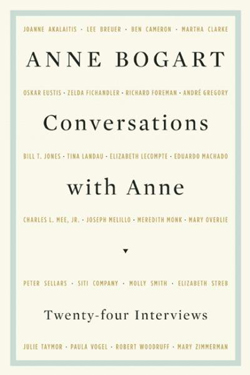
Anne Bogart. 2012, 507 pages, Theatre Communications Group, New York
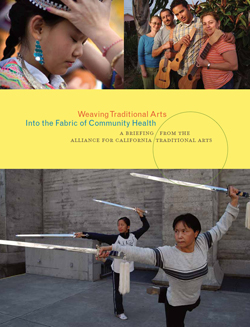
Download:
 Weaving Traditional Arts into the Fabric of Community Health (1 Mb)
Spurred on by technological advances, the number of aspiring professional artists in the United States has reached unprecedented levels. The arts’ current system of philanthropic support is woefully underequipped to evaluate this explosion of content — but we believe that the solution to the crisis is sitting right in front of us. Philanthropic institutions, in their efforts to provide stewardship to a thriving arts community, have largely overlooked perhaps the single most valuable resource at their disposal: audience members.
Funders, arts administrators, and other people trying their hand at creative placemaking (artists and more unlikely suspects) find their way to me. Because I coauthored Creative Placemaking, the 2010 white paper for the NEA’s Mayors’ Institute on City Design, I’m an authority, yet folks get through to me with a cold call or email, instead of waiting for an announced webinar from the National Endowment for the Arts or ArtPlace or trying to read between the lines of application guidelines.
This article is a reprinting of a blog originally posted on ArtWorks. See that post at http://www.arts.gov/artworks/?p=11955.
“Theatres are the best way to keep people from the arts.”
— Simon Dove, Utrecht Festival, Dance/USA Forum, January 2011
— Simon Dove, Utrecht Festival, Dance/USA Forum, January 2011
Why will some people engage with art in one setting, but not another? For example, why will someone watch great drama on television at home, but never darken the door of a theater? Why will someone listen to classical music in a place of worship, but not a concert hall?
Enriching our culture and engaging diverse and underserved communities, small arts organizations pop up, flourish, and sometimes flounder, mostly under the philanthropic radar. They often foster artistic expressions not adequately served by larger organizations.
The business section of the most recent Sunday New York Times featured an article by Caitlin Kelly on artists' relief funds and the significant impact they have on an artist's ability to recover from a career-threatening emergency. The article includes interviews with emergency funders like Cornelia Carey, executive director of GIA member CERF+. The article can be found on the Times website, here.