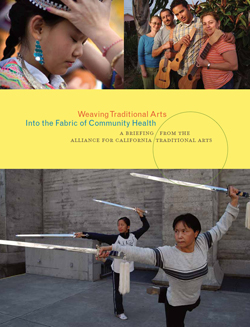
Download:
 Weaving Traditional Arts into the Fabric of Community Health (1 Mb)
Contact GIAGIA Reader PublicationBecome A GIA Member
450 Lexington Ave, Unit 4501 | New York, NY | gia@giarts.org

The GIA Library is an information hub that includes articles, research reports, and other materials covering a wide variety of topics relevant to the arts and arts funding. These resources are made available free to members and non-members of GIA. Users can search by keyword or browse by category for materials to use in research and self-directed learning. Current arts philanthropy news items are available separately in our news feed - News from the Field.
Download:
Weaving Traditional Arts into the Fabric of Community Health (1 Mb)
Funders, arts administrators, and other people trying their hand at creative placemaking (artists and more unlikely suspects) find their way to me. Because I coauthored Creative Placemaking, the 2010 white paper for the NEA’s Mayors’ Institute on City Design, I’m an authority, yet folks get through to me with a cold call or email, instead of waiting for an announced webinar from the National Endowment for the Arts or ArtPlace or trying to read between the lines of application guidelines.
Enriching our culture and engaging diverse and underserved communities, small arts organizations pop up, flourish, and sometimes flounder, mostly under the philanthropic radar. They often foster artistic expressions not adequately served by larger organizations.
Download:
Designing a Twenty-First Century Cultural Hub to Build Community (839Kb)
Before the house lights dim at a production of Romeo and Juliet, I look for myself and I am delighted to find myself as I was many years ago: A teenaged boy sitting by himself. I recognize him because he keeps checking the number on his ticket against the number on the armrest. All in all, he is pleased with his seat. He wears a sweater and tie. He reads his program with the intensity I used similarly to scrutinize the actors’ biographies, the director’s notes, and the advertisements for after-theater dining.
Ralph Smith, the 2007 Conference Chairman, issued a challenge in his welcome message – “that all who attend will leave with renewed energy, capacity and resolve to make a positive contribution toward meeting the challenges of our time.”
2010, 72 pages, The Urban Institute, 2100 M Street NW, Washington, D.C., 20037, (202) 833-7200 http://www.urban.org
Download:
Council on Foundations Annual Conference, May 1, 2001
Craig McGarvey, The James Irvine Foundation
From a position of received privilege, how should one behave so that it might be put to productive use as people are learning to get better at their work? This is a central question facing philanthropy, and it figured centrally in preparations for today. How to say something appropriate and helpful under such extraordinary circumstances?
There was the problem that no single foundation's body of work could possibly measure up to being singled out.
2008, 661 pages. Sage Publications, 2455 Teller Road, Thousand Oaks, CA, 91320, www.sagepublications.com
http://www.uk.sagepub.com/booksProdDesc.nav?prodId=Book230746
This text analyses the dynamic relationship in which culture is part of the process of economic change that in turn changes the conditions of culture. It brings together perspectives from different disciplines to examine such critical issues as:
In the past two years, several prominent foundations at national, regional, and local levels have appointed new presidents. Such leadership transitions are likely to increase in the years ahead in keeping with the larger generational shift in the nonprofit sector. Very few of the new foundation leaders are likely to come from the arts sector, and many will have had little direct experience with our field.