September 2015, 58 pages. DeVos Institute of Arts Management, 1300 Pennsylvania Ave NW, Suite 410, Washington, D.C. 20004. (301) 314-0963. www.devosinstitute.net.
Download:
Contact GIAGIA Reader PublicationBecome A GIA Member
450 Lexington Ave, Unit 4501 | New York, NY | gia@giarts.org

The GIA Library is an information hub that includes articles, research reports, and other materials covering a wide variety of topics relevant to the arts and arts funding. These resources are made available free to members and non-members of GIA. Users can search by keyword or browse by category for materials to use in research and self-directed learning. Current arts philanthropy news items are available separately in our news feed - News from the Field.
September 2015, 58 pages. DeVos Institute of Arts Management, 1300 Pennsylvania Ave NW, Suite 410, Washington, D.C. 20004. (301) 314-0963. www.devosinstitute.net.
Download:
Despite New York City’s status as the dance capital of the United States, rising real estate prices are challenging the city’s ability to serve as a creative incubator, with space — an essential resource for making dance — in waning supply. Choreographers and dancers need to work in a large open area with a sprung floor, but as real estate values climb, long-standing dance studios are being bought by developers and converted into residential or commercial spaces.
Download:
 Redefining Expectations for Place-based Philanthropy (10.2 Mb)
This article discusses how The California Endowment has used a midcourse strategic review to refine Building Healthy Communities, aiming to provide insight for other place-based initiatives and to add to the body of knowledge about how to support transformative community change.
Even folks entirely unfamiliar with the concept of creative placemaking intuitively grasp the potential for artist spaces to catalyze revitalization, and mural projects to animate vacant walls. The usual mental backdrops, however, are down-and-out urban neighborhoods.
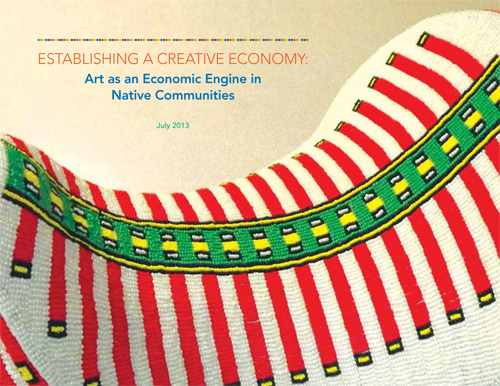
July 2013, 40 pages. First Peoples Fund, P.O. Box 2977, Rapid City, South Dakota, 57709, firstpeoplesfund.org.
Download:
Bill Ivey. 2012, 192 pages, Counterpoint.
In his new book we learn about many of the things Bill Ivey doesn’t like:
And we learn about some of the things Bill Ivey does like:
While I was volunteering at the Park Slope Armory evacuation shelter I asked for advice from a member of the clergy when I encountered a problem I couldn’t solve. He told me to follow my instinct. I said I didn’t trust my instinct; the situation was far beyond my experience. He responded, “This is your opportunity to stretch yourself.” A lot of stretching has been going on in the aftermath of Hurricane Sandy. People, organizations, and communities have been coming together to meet a challenge and stretch in ways we had no idea were pos-sible.
About four years ago I attended an extraordinary meeting in Philadelphia. Susan Nelson, principal of Technical Development Corporation (TDC), was presenting the draft of Getting Beyond Breakeven to the Greater Philadelphia Cultural Alliance and many other stakeholders associated with the work.
Creative placemaking is electrifying communities large and small around the country. Mayors, public agencies, and arts organizations are finding each other and committing to new initiatives. That’s a wonderful thing, whether or not their proposals are funded by national initiatives such as the National Endowment for the Arts’ Our Town program or ArtPlace.