
Funders, arts administrators, and other people trying their hand at creative placemaking (artists and more unlikely suspects) find their way to me. Because I coauthored Creative Placemaking, the 2010 white paper for the NEA’s Mayors’ Institute on City Design, I’m an authority, yet folks get through to me with a cold call or email, instead of waiting for an announced webinar from the National Endowment for the Arts or ArtPlace or trying to read between the lines of application guidelines.
Search
The GIA Library is an information hub that includes articles, research reports, and other materials covering a wide variety of topics relevant to the arts and arts funding. These resources are made available free to members and non-members of GIA. Users can search by keyword or browse by category for materials to use in research and self-directed learning. Current arts philanthropy news items are available separately in our news feed - News from the Field.
Enriching our culture and engaging diverse and underserved communities, small arts organizations pop up, flourish, and sometimes flounder, mostly under the philanthropic radar. They often foster artistic expressions not adequately served by larger organizations.
This essay is the keynote address delivered at the GIA 2010 Conference, October 19, 2011.
I believe that this cause and its implementation has a worldwide application; for as our cultural life is enhanced and strengthened, so does it project itself into the world beyond our shores. Let us apply renewed energies to the very concept we seek to advance: a true renaissance — the reawakening, the quickening, and above all, the unstunted growth of our cultural vitality.
December 2011, 38 pages. National Endowment for the Arts, 1100 Pennsylvania Avenue NW, Washington, DC 20506, (202) 682-5400, www.ars.gov
Download:
 The Arts and Human Development (2.4Mb)
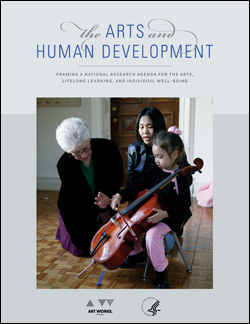
Overview
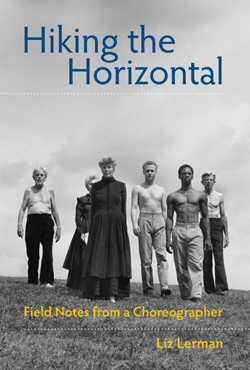
2011, 332 pages, Wesleyan University Press, Middletown, CT
Liz Lerman's body of work has come to symbolize the participatory community arts movement, and this collection of essays delightfully chronicles both her artistic growth as a choreographer and the intellectual process that led her to this path that revolutionized the ways in which dance is developed, performed, and experienced.
Maryo Gard Ewell worked for more than thirty years in arts administration. Her special field during most of that time was the symbiotic relationship between arts programs and community development. Since her retirement in 2003 from the Colorado Council on the Arts, she has worked as a consultant, conference organizer, and speaker in community and arts development. Ewell literally grew up in the community arts movement.
Fearless Journeys: Innovation in Five American Orchestras is the report of a 2009 study, funded by MetLife Foundation, which explored and documented five examples of promising innovative practices in American orchestras. This is the first formal attempt to define and to understand the organizational factors that support innovation in orchestras.
2010, 72 pages, The Urban Institute, 2100 M Street NW, Washington, D.C., 20037, (202) 833-7200 http://www.urban.org
Download:
Remix: Making Art and Commerce Thrive in the Hybrid Economy; Lawrence Lessig, Penguin Press, 2008, 352 pages. ISBN-10: 1594201722
In the past two years, several prominent foundations at national, regional, and local levels have appointed new presidents. Such leadership transitions are likely to increase in the years ahead in keeping with the larger generational shift in the nonprofit sector. Very few of the new foundation leaders are likely to come from the arts sector, and many will have had little direct experience with our field.