
There is no doubt that the face of art and culture in the United States is changing.
Search
The GIA Library is an information hub that includes articles, research reports, and other materials covering a wide variety of topics relevant to the arts and arts funding. These resources are made available free to members and non-members of GIA. Users can search by keyword or browse by category for materials to use in research and self-directed learning. Current arts philanthropy news items are available separately in our news feed - News from the Field.
From Diane Ragsdale on her Jumper blog:
While it may make everyone feel better in the short term is it possible this tendency to make it appear that donor gifts (large and small) can accomplish far more than is realistic has long term negative impacts on the organization and its relationship with its donors and the community-at-large? Is it possible we avoid telling the real truth because we don’t want to confront or invite others to look to closely at the total cost of ownership of our buildings, or the real costs of running our institutions and particular programs, or how much and how little (relatively speaking) is spent on various areas of operation and resources?
The National Endowment for the Arts will host Improving Arts Learning through Standards & Assessment: A National Endowment for the Arts Research Roundtable, a webcast and roundtable discussion, on Tuesday, February 14, 2012 beginning at 8:30AM and running to 3:00PM EST. No pre-registration is necessary. To view the webcast simply log on to the NEA’s website at the scheduled date and time.
Tuesday, June 19, 2:00 EDT/ 11:00 PDT [PASSED]
Douglas McLennan, ArtsJournal.com
Bill O'Brien, National Endowment for the Arts
Session 3 of the 2012 Web Conference Series
A recording of this presentation is available here.
This series is free to the staff and board members of GIA member organizations. The fee for nonmembers is $35 per session.
Description:
January 2012, 112 pages. W.K. Kellogg Foundation, One Michigan Avenue East, Battle Creek, MI 49017-4012, (269) 968-1611, www.wkkf.org
The Native Arts and Culture Foundation has launched its first artist fellowships program for Native artists to promote further development of their talents. 2011 NACF Artist Fellowships honor Native artists that have made a significant impact in their discipline, are respected by their colleagues and in the greater arts field, and who are emerging as powerful voices in the arts.
From Diane Ragsdale in her Jumper blog:
Direct grants to artists may make it possible for an artist, at a particular point in his or her career, to make (better or more ambitious) work (by removing the necessity to maintain a day job). Funds may be used to help an artist acquire a critical resource or asset that has longer term returns (a marketable artistic output, knowledge and skills, marketing and promotion, staff, representation, a piece of equipment, a studio, a car, etc.). And often direct grants (particularly if competitve or associated with awards) send a signal to other gatekeepers (funders, donors, producers, press, intermediaries, curators, etc.) that a particular artist is worthy of time and support and may result in more resources and attention flowing to that artist.
December 2011, 38 pages. National Endowment for the Arts, 1100 Pennsylvania Avenue NW, Washington, DC 20506, (202) 682-5400, www.ars.gov
Download:
 The Arts and Human Development (2.4Mb)
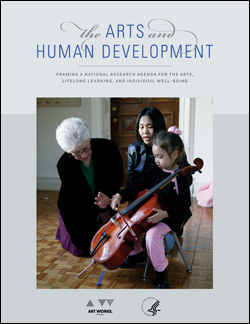
Overview
by John McGuirk (bio), program director, Performing Arts Program, The William and Flora Hewlett Foundation Fusing Arts, Culture and Social Change raises critical issues that arts funders should address to minimize disparities to accessible and relevant arts opportunities for all … Continue reading
October 2011, 32 pages. Monitor Institute, 101 Market Street, Suite 1000, San Francisco, CA, 94101, (415) 932-5300 www.monitorinstitute.com.