
Just societies cannot grow in toxic soil. To build regenerative communities, we should look to how life flourishes in the natural world, of which we are an inherent part.
Contact GIAGIA Reader PublicationBecome A GIA Member
450 Lexington Ave, Unit 4501 | New York, NY | gia@giarts.org

The GIA Library is an information hub that includes articles, research reports, and other materials covering a wide variety of topics relevant to the arts and arts funding. These resources are made available free to members and non-members of GIA. Users can search by keyword or browse by category for materials to use in research and self-directed learning. Current arts philanthropy news items are available separately in our news feed - News from the Field.
Just societies cannot grow in toxic soil. To build regenerative communities, we should look to how life flourishes in the natural world, of which we are an inherent part.
Do you think that we are living in a zeitgeist of catalytic change? I have heard the word catalytic used so frequently that I find myself accessorizing moments with this adjective as if it holds the weight of tectonic shifts. It seems to promise the kind of change that either redirects historical systems of oppression toward equity — gradually erasing calcified notions of otherness that fuel supremacist behaviors — or catapults us back into a time where Flintstones-like ideals become presidential norms.
What can you do when times are uncertain, and yet a clear opportunity to advance a collective agenda presents itself? Take action.
On May 25, 2016, Grantmakers in the Arts gathered a cross-section of twenty-eight funders from the arts and environmental sectors for the Arts and Environmental Sustainability Thought Leader Forum at the New York Community Trust. Most foundations in attendance were represented by two people: a person from the arts and a person from the environment, each of whom were interested in collaborative work at this intersection. Helicon Collaborative organized and facilitated the session.
In 2008 I wrote Le facteur C (later translated as No Culture, No Future) because I felt an urgent need to respond to a troubling trend: a growing chasm between the art experiences that were being offered by arts professionals and those being sought out by an ever-growing portion of the public. My book argued that for the arts to thrive and to be a force in our everyday lives, the professional arts sector needed to do more and differently to engage people in the arts in meaningful, life-enriching ways.
“Black people did not come back from Georgia.”
“A man or woman that had learned that they might be taken south might do anything.”
“A man who had to see his son stand naked before buyers might do anything.”
Over the past few decades, arts advocates have toiled diligently to support and sustain the arts in a climate that has not always felt very welcoming. Culture wars, economic recessions, technological disruptions, accusations of elitism, and (most frightening, perhaps) the perceived menace of societal indifference have at times all conspired to create an impression for many of an arts ecology under perpetual threat.
In January I had the privilege to attend the Future Aesthetics 2.0 retreat, co-organized by Marc Bamuthi Joseph, director of Performing Arts of the Yerba Buena Center for the Arts, and James Kass, executive director of Youth Speaks. Participating were twenty-three performance-based artists, Helicon Collaborative partners Holly Sidford and Alexis Frasz, and Cheryl Ikemiya from the Doris Duke Charitable Foundation, which funded the project through its Fund for National Projects.
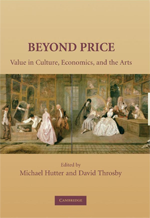
Beyond Price: Value in Culture, Economics, and the Arts; Edited by Michael Hutter and David Throsby; Cambridge University Press, 2007, 324 pages
Ralph Smith, the 2007 Conference Chairman, issued a challenge in his welcome message – “that all who attend will leave with renewed energy, capacity and resolve to make a positive contribution toward meeting the challenges of our time.”