
Artist Titus Kaphar; Wu Tsang, filmmaker and performance artist; Becca Heller, human rights lawyer; William Barber Jr., pastor and activist, and Vijay Gupta, violinist and social-justice advocate, are among the 2018 MacArthur Foundation's 'Genius' fellows.
Search
The GIA Library is an information hub that includes articles, research reports, and other materials covering a wide variety of topics relevant to the arts and arts funding. These resources are made available free to members and non-members of GIA. Users can search by keyword or browse by category for materials to use in research and self-directed learning. Current arts philanthropy news items are available separately in our news feed - News from the Field.
An American lady traveling to Paris in 1913 — the kind of American lady who will still be traveling to Paris in 2013 — asked Ezra Pound what he thought art was for. Pound replied: “Ask me what a rose bush is for.”
Europe was on the edge of war. Do rose bushes matter in a war? What can art do for us now, in the likelihood of another war?
Bill Ivey. 2012, 192 pages, Counterpoint.
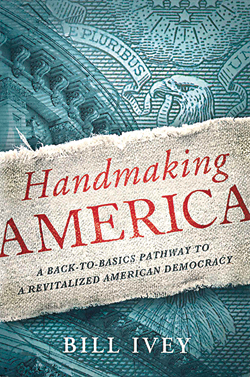
In his new book we learn about many of the things Bill Ivey doesn’t like:
- banner ads
- smart phones
- the $6 billion yoga industry
- politicians who hide behind polling
- cable news
- $4,000 mountain bikes
- TV in general; cooking shows in particular
And we learn about some of the things Bill Ivey does like:
- Leica cameras
December 2011, 38 pages. National Endowment for the Arts, 1100 Pennsylvania Avenue NW, Washington, DC 20506, (202) 682-5400, www.ars.gov
Download:
 The Arts and Human Development (2.4Mb)
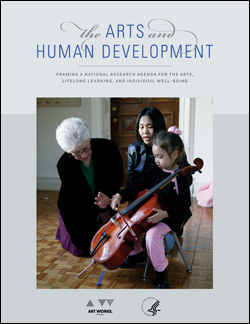
Overview
Speech delivered at the Council on Foundations Family Foundation Conference, February 2, 2010, San Diego
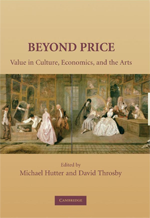
Beyond Price: Value in Culture, Economics, and the Arts; Edited by Michael Hutter and David Throsby; Cambridge University Press, 2007, 324 pages
The art that matters to us … is received by us as a gift is received. Even if we have paid a fee at the door of the museum or concert hall, when we are touched by a work of art something comes to us that has nothing to do with the price.
— Lewis Hyde
— Lewis Hyde
Many of the feature articles in this issue offer tools for responding to GIA Executive Director Janet Brown's call to speak up, to not sit silently in the back but to stand up and illustrate or make the case for why arts and culture matters.
In the past two years, several prominent foundations at national, regional, and local levels have appointed new presidents. Such leadership transitions are likely to increase in the years ahead in keeping with the larger generational shift in the nonprofit sector. Very few of the new foundation leaders are likely to come from the arts sector, and many will have had little direct experience with our field.
Between 2006 and 2008, the Social Impact of the Arts Project, a research group at the University of Pennsylvania (SIAP), collaborated with The Reinvestment Fund (TRF), a community development financial institution, on an investigation of the creative sector's potential contribution to neighborhood economic and community development.
Arts and education grantmakers at an historic gathering in Santa Fe in October of 2007 agreed on the need to forge a new vision for public education in the United States and to collectively explore how the arts can help shape and realize that vision.
Convened by Grantmakers in the Arts and Grantmakers for Education, more than 100 foundation representatives met formally for the first time under the aegis of their two affinity organizations to debate and discuss the role of the arts in education.