Grantmakers in the Arts

by Janet

By Janet Brown from her blog Better Together.

Last month, I was fortunate to be invited to a small gathering of scientists and artists at the Nevada Museum of Art in Reno sponsored by the National Science Foundation. Undaunted by the academic title of the convening, “Examining Complex Ecological Dynamics through Arts, Humanities and Science Integration,” I attended with a colleague and GIA member, Bill O’Brien, senior innovation advisor to the chairman of the National Endowment for the Arts. Bill and I joined artists and scientists who are primarily working at scientific field stations focused on environmental data collection and research.
by Steve

Nearly 28 million U.S. adults have some type of disability related to hearing, sight, cognition, walking, and other activities of daily living. A Matter of Choice? Arts Participation Patterns of Disabled Americans offers the first nationally representative analysis of arts-participation patterns among people with disabilities.

by SuJ'n

For the month of July, GIA's photo banner features the recipients of The Surdna Foundation's Artists Engaged in Social Change awards and their work. Founded in 1917 by John Emory Andrus, the Foundation seeks to foster sustainable communities in the US that are guided by principles of social justice and distinguished by healthy environments, strong local economies, and thriving cultures.

by Steve

From T. Lulani Arquette, President/CEO of the Native Arts and Cultures Foundation, and a current member of the GIA Board of Directors:

In my lifetime, I have not seen this level of racial discrimination and hatred in our country since the 1960’s and early 1970’s. As a very young girl, too innocent to understand what was going on, but intuitive enough to know that something very wrong was happening, I remember seeing on national television these horrific images of police dogs and fire hoses turned on the demonstrators in Birmingham, the violence at the Pettus Bridge in Selma, and the burning neighborhoods of the Watts riots in Los Angeles. These images from Alabama and California flashed on TV screens across our nation and stayed with me for a long time.
by Steve

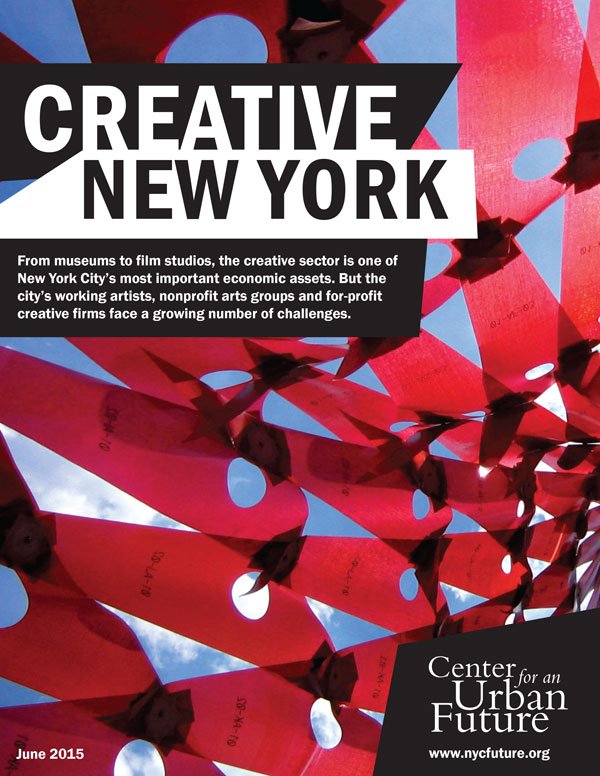
A new report from the Center for an Urban Future looks into the state of New York’s creative sector to see how the people working there are doing in the wake of the city’s economic surge and the transition to a new administration. After an unprecedented investment in cultural capital projects and a strong emphasis on promoting tourism during the Bloomberg administration, New York Mayor Bill de Blasio is taking steps to ensure that opportunities to produce and consume culture are broadly shared and that working artists and creative professionals can afford to live and work there. Creative New York proposes more than 20 steps that the de Blasio administration can take to address and ultimately overcome the chief obstacles documented in the report, that was authored by Adam Forman with financial support from New York Community Trust, Robert Sterling Clark Foundation, Laurie M. Tisch Illumination Fund, Rockefeller Brothers Fund and Edelman.

by Steve

By Ray Mark Rinaldi, Fine Arts Critic for The Denver Post:

Change comes slowly in the world of private foundations, and there’s a kind of comfort in that. Foundations are the bedrock funders of important institutions, like hospitals, universities and museums, and their dedicated giving is crucial to cities that count on their cash. But three years ago, Denver’s Bonfils-Stanton Foundation took a chance on change. Long a contributor to causes across the board, from homeless shelters to opera companies, the organization began steering all of its funding toward the arts. Culture needed the money, the thinking went, and by targeting one area, the foundation could set itself apart from its peers and become a real player in the community.
by Steve in Arts Education

Earlier this year, Arts Education Partnership (AEP) announced that the National Endowment for the Arts and the U.S. Department of Education have initiated a process for finding a new home for AEP.The NEA has now released the Program Solicitation for the AEP, a competitive process to find the AEP a new home in January 2016. The Arts Endowment requires organizations to submit their proposals electronically through Grants.gov, the federal government’s online application system.

by Steve

Bloomberg Philanthropies Public Art Challenge — a program aimed at supporting temporary public art projects that engage communities, enhance creativity and enrich the vibrancy of cities — has announced four winning projects:

  • Albany, Schenectady and Troy, New York — Breathing Lights, from artist Adam Frelin
  • Gary, Indiana — ArtHouse: A Social Kitchen, from artist Theaster Gates
  • Los Angeles, California — CURRENT: LA River, from artists to be selected
  • Spartanburg, South Carolina — Seeing Spartanburg in a New Light, from artist Erwin Redl