I pulled my car out of the driveway and parked in front of my neighbors’ house across the street. A few moments later, my friend, Marvin Morales, a thirty-one-year-old Guatemalan PhD student in biology at the University of Florida, opened the door. His right arm hung across his shirtless torso in a navy-blue sling. Across his collarbone there was a rectangular piece of gauze. I asked Marvin how he was feeling. Not good, he said. The pain in his shoulder had kept him up most of the night.
Search
The GIA Library is an information hub that includes articles, research reports, and other materials covering a wide variety of topics relevant to the arts and arts funding. These resources are made available free to members and non-members of GIA. Users can search by keyword or browse by category for materials to use in research and self-directed learning. Current arts philanthropy news items are available separately in our news feed - News from the Field.
I was privileged to have facilitated GIA’s Funder Forum on Arts in Medicine this past February in Orlando, Florida. In that role, I had the opportunity to listen to and learn from the gathered practitioners and funders. Since then, I have reflected on what for me was an exceptional day of sharing and exchange that I think benefited both the participants and the growing arts-in-medicine field. Here is some of what emerged.
One of the key issues of our time is health care. We know that it is complicated because of its vast scale of services and intimate reach into every life, family, and community in this country. The search for access to high-quality health care for millions of Americans is often difficult. Medical advances of the twentieth and the twenty-first centuries have extended the life span, cured pandemic diseases like polio, and have made it possible to manage chronic illnesses once debilitating.
Old people have danced forever. We just forgot that for a time.
— Liz Lerman
In June, Ellen Michelson, president of Aroha Philanthropies, and I attended the first National Leadership Exchange of the National Center for Creative Aging in Washington, D.C. It was an extraordinary conference, filled with inspiration and information on this emerging field.
September 2013, 9 pages. Grantmakers In Health, 1100 Connecticut Avenue NW, Suite 1200, Washington, DC 20036, (202) 452-8331, gih.org.
Download:
 Innovative Crossroads: The Intersection of Creativity, Health, and Aging (221 Kb)
There is no doubt that the face of art and culture in the United States is changing.
December 2011, 38 pages. National Endowment for the Arts, 1100 Pennsylvania Avenue NW, Washington, DC 20506, (202) 682-5400, www.ars.gov
Download:
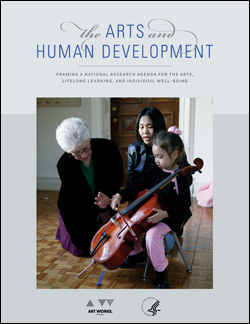
The Arts and Human Development (2.4Mb)