December 2011, 38 pages. National Endowment for the Arts, 1100 Pennsylvania Avenue NW, Washington, DC 20506, (202) 682-5400, www.ars.gov
Download:
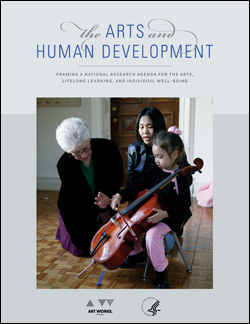
 The Arts and Human Development (2.4Mb)
Contact GIAGIA Reader PublicationBecome A GIA Member
450 Lexington Ave, Unit 4501 | New York, NY | gia@giarts.org

The GIA Library is an information hub that includes articles, research reports, and other materials covering a wide variety of topics relevant to the arts and arts funding. These resources are made available free to members and non-members of GIA. Users can search by keyword or browse by category for materials to use in research and self-directed learning. Current arts philanthropy news items are available separately in our news feed - News from the Field.
December 2011, 38 pages. National Endowment for the Arts, 1100 Pennsylvania Avenue NW, Washington, DC 20506, (202) 682-5400, www.ars.gov
Download:
The Arts and Human Development (2.4Mb)
2009, 31 pages. Grantmakers for Education, 720 SW Washington Street, Suite 605, Portland, OR, 97205, 503-595-2100, www.edfunders.org
http://www.edfunders.org/downloads/GFEReports/
SchoolLeadershipChallenge.pdf
Arts and education grantmakers at an historic gathering in Santa Fe in October of 2007 agreed on the need to forge a new vision for public education in the United States and to collectively explore how the arts can help shape and realize that vision.
Convened by Grantmakers in the Arts and Grantmakers for Education, more than 100 foundation representatives met formally for the first time under the aegis of their two affinity organizations to debate and discuss the role of the arts in education.
Evaluations of arts education programs raise some of the greatest challenges I face in reviewing proposals. Even in a secular age, when people are pressed to describe the nature of art, they come to words like "essence." How do we get to a point where we know that children have learned to make and to encounter that kind of knowing?
There are an abundance of theories — and even more clichés — about why the arts should be in young people's lives. However, academically rigorous research that demonstrates the power of the arts is scarce. This article summarizes a decade of research by a team of anthropologists in after-school programs identified by young people themselves as high quality. The researchers found common characteristics that made these programs successful, whether their focus was academic, sport, community service, or the arts. The balance of these characteristics differs among programs, though.
Edited by Barbara Rich, Ed.D, Jane L. Polin, Stephen J. Marcus
2003, 164 pages. The Dana Foundation, 745 Fifth Avenue, Suite 900, New York, NY 10151, 212-223-4040, daninfo@dana.org, www.dana.org.
2002, 30 pages, Cultural Initiatives Silicon Valley. To order a copy, contact Brendan Rawson, brendan@ci-sv.org or 408-283-8506
2003, 79 pages. Department of Art Education, Ohio State University, 128 North Oval Mall, Room 258, Columbus, OH 43210, 614-292-5649
This final report on Transforming Education Through the Arts Challenge (TETAC) is more than a compilation of the results of a five-year initiative to link comprehensive approaches to arts education with national and local school reform efforts.
We just returned from yet another community gathering where arts leaders sought the support of their business and civic counterparts by documenting the "economic impact" of arts spending and employment in their region.
