December 2011, 38 pages. National Endowment for the Arts, 1100 Pennsylvania Avenue NW, Washington, DC 20506, (202) 682-5400, www.ars.gov
Download:
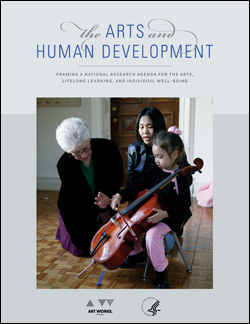
 The Arts and Human Development (2.4Mb)
Contact GIAGIA Reader PublicationBecome A GIA Member
450 Lexington Ave, Unit 4501 | New York, NY | gia@giarts.org

The GIA Library is an information hub that includes articles, research reports, and other materials covering a wide variety of topics relevant to the arts and arts funding. These resources are made available free to members and non-members of GIA. Users can search by keyword or browse by category for materials to use in research and self-directed learning. Current arts philanthropy news items are available separately in our news feed - News from the Field.
December 2011, 38 pages. National Endowment for the Arts, 1100 Pennsylvania Avenue NW, Washington, DC 20506, (202) 682-5400, www.ars.gov
Download:
The Arts and Human Development (2.4Mb)
Many of the feature articles in this issue offer tools for responding to GIA Executive Director Janet Brown's call to speak up, to not sit silently in the back but to stand up and illustrate or make the case for why arts and culture matters.
Between 2006 and 2008, the Social Impact of the Arts Project, a research group at the University of Pennsylvania (SIAP), collaborated with The Reinvestment Fund (TRF), a community development financial institution, on an investigation of the creative sector's potential contribution to neighborhood economic and community development.
Arts and education grantmakers at an historic gathering in Santa Fe in October of 2007 agreed on the need to forge a new vision for public education in the United States and to collectively explore how the arts can help shape and realize that vision.
Convened by Grantmakers in the Arts and Grantmakers for Education, more than 100 foundation representatives met formally for the first time under the aegis of their two affinity organizations to debate and discuss the role of the arts in education.
Evaluations of arts education programs raise some of the greatest challenges I face in reviewing proposals. Even in a secular age, when people are pressed to describe the nature of art, they come to words like "essence." How do we get to a point where we know that children have learned to make and to encounter that kind of knowing?
From May 29 through June 1 of this year, seventy-eight individuals interested in the arts in the United States came together for the 92nd American Assembly at Arden House in Harriman, New York to debate "The Arts and the Public Purpose." The American Assembly was established by Dwight D. Eisenhower at Columbia University in 1950. Each year it holds at least two nonpartisan meetings on topics related to United States policy, each of which gives rise to a book on the subject discussed.
2006, 114 pages. Published by the University of Minnesota, Humphrey Institute of Public Affairs, Project on Regional and Industrial Economics (PRIE). Funded by the McKnight Foundation and the Fesler-Lampert Chair in Urban and Regional Affairs, University of Minnesota.
The fall 2002 issue of the Reader (volume 13, number 3) introduced an ongoing feature, "Why Art?" as a response to GIA's goal to strengthen the role of arts and culture in philanthropy and in society as a whole. This Reader feature aims to help members and others make stronger arguments for the support of arts and culture by sharing examples of arguments, case statements, insights, and stories that convey the multifaceted role that culture, the arts, and artists play in our society, neighborhoods, and individual lives.
2004. Centre for Creative Communities, 118 Commercial St., London E16NF, UK.