
Adults age sixty-five and above are currently the fastest-growing segment of the US population. In 2016, there were 47.8 million individuals age sixty-five and over in the United States (US Census Bureau 2017), and this number is expected to more than double by 2060. By 2040, nearly half of older adults are expected to come from diverse racial/ethnic and socioeconomic backgrounds (Vincent and Velkoff 2010; Johnson, Rodriquez-Salazar, et al. 2018). San Francisco’s population of older adults is higher than the national norm.
Search
The GIA Library is an information hub that includes articles, research reports, and other materials covering a wide variety of topics relevant to the arts and arts funding. These resources are made available free to members and non-members of GIA. Users can search by keyword or browse by category for materials to use in research and self-directed learning. Current arts philanthropy news items are available separately in our news feed - News from the Field.
When tasked with presenting the dynamic and multiscalar ecosystem of arts and culture in the Bay Area, the Grantmakers in the Arts team knew that we needed to call upon those engaging deeply with the forces effecting change. Given the evolving nature of space availability, access, and affordability in cities, any system of disruption will, by design, engage a diversity of stakeholders and intervene at multiple levels. From the strongly held position that the arts drive strong, vibrant, diverse communities, Community Arts Stabilization Trust (CAST) exemplifies one such model.
Today, Regina’s Door in Oakland serves as a healing artistic space for survivors of sex trafficking, as well as a launching pad for theatrical productions featuring the stories and performances of survivors. Its start came in 2014, when Regina Evans decided she needed to do something to help her community. “We have young girls being brutalized every day. In Oakland trafficking is very hidden, but if you go down International Boulevard, you also see very young girls — twelve, thirteen, fourteen years old, and you know they’re being raped,” she said.
As arts funders, we know that extensive research has shown that the presence of arts and culture activities at the neighborhood level can improve health and safety and promote a sense of well-being among residents. But how do we identify what activities already exist in a community and, as important, where there are gaps so we can be proactive in advancing a community’s livability?
If there is in society a collective consciousness, then art is its imagination. Imagination is different from fantasy, which conjures up desires divorced from reality; imagination is creative problem solving that assesses what is available and re-creates it into something new, better, or self-satisfying. Detroit has been short on many things over the past fifty years — economic prosperity, functioning city services, racial justice, validation — but it is astonishingly long on imagination and creative problem solving.
As our country prepares for a Trump presidency, the issue of economic revitalization in rural American has much more urgency than eight months ago when I started collecting data for this work. Here is a sampling of headlines from coverage by the New York Times of the economic decline in the rust belt, or more specifically, coal country and Appalachian towns: “Trump’s Promises Will Be Hard to Keep, but Coal Country Has Faith” (Nov. 28, 2016); “A Bleak Outlook for Trump’s Promises to Coal Miners” (Nov.
In 2015, Americans for the Arts partnered with the National Endowment for the Arts to conduct the Local Arts Agency Census, the most comprehensive survey of the local arts agency field ever conducted. Its purpose was to illuminate the ever-adapting role these organizations play in ensuring the arts have a vital presence in every community.
What Is a Local Arts Agency?
The woman on the phone was friendly but insistent. “Look,” she said, “more and more artists and arts organizations are taking on cross-sector community-based work. But this is a complex gig, and, unfortunately, many of them are in over their heads.” It was a blunt assessment, but I knew she was right. “Yeah, I’m seeing the same thing out in the field. So, what do you think is needed?” Her response? … One word: “Training!”
The 1960s was a time of ferment and creation on so many fronts. In the arts, we note explosive growth in the number of significant professional arts institutions as well as countless locally based arts organizations, from chamber orchestras to theater companies; the birth and growth of culturally specific arts groups and arts centers; the creation of arts groups in support of, and arising from, the civil rights movement; the rapid increase in the number of community arts councils, especially in small cities; the birth of Community Arts Councils, Inc.
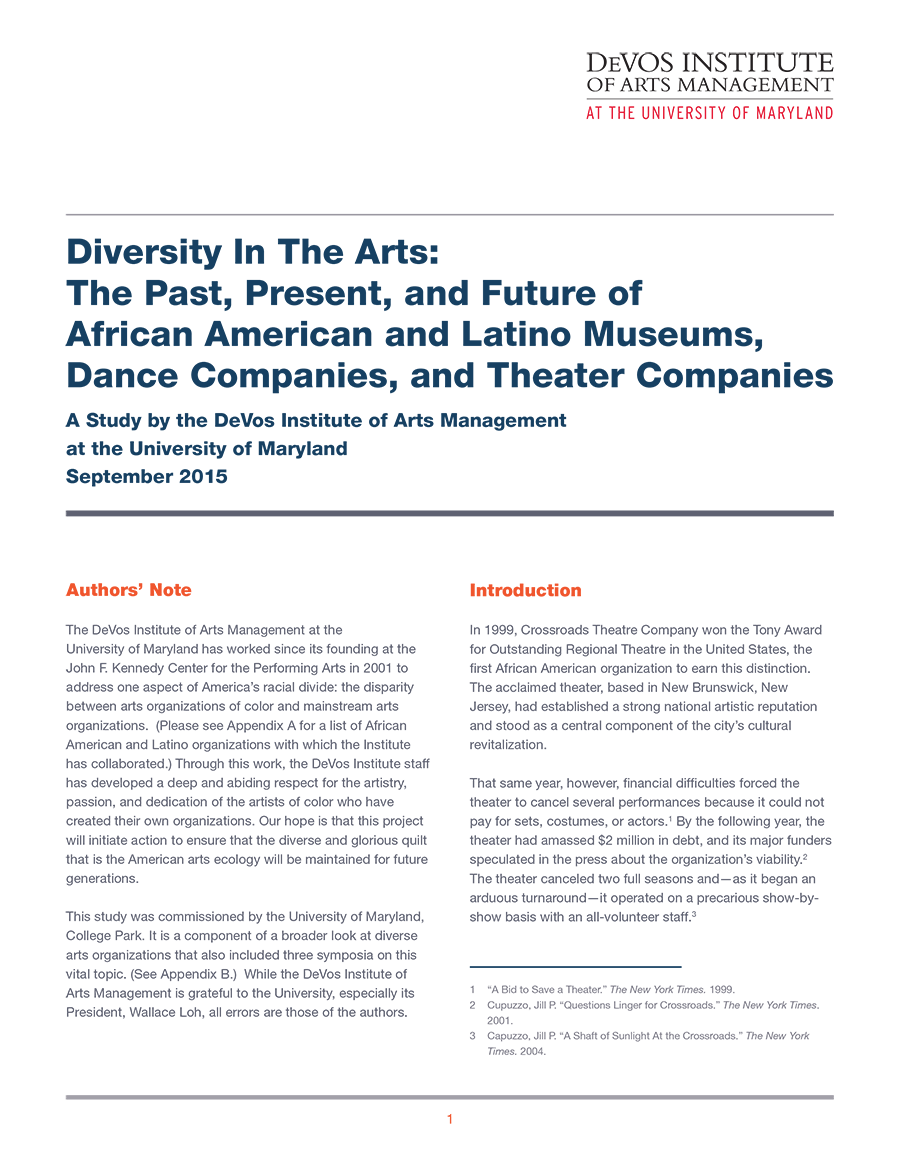
September 2015, 58 pages. DeVos Institute of Arts Management, 1300 Pennsylvania Ave NW, Suite 410, Washington, D.C. 20004. (301) 314-0963. www.devosinstitute.net.
Download: