
In other cultures Meredith Monk would be called shaman, seer, healer; here we struggle to define her interdisciplinary prowess. Singer/composer, dancer/choreographer, actor/performer, director/playwright, visual artist/filmmaker — even together, these categories cannot capture her resplendent achievements.
Search
The GIA Library is an information hub that includes articles, research reports, and other materials covering a wide variety of topics relevant to the arts and arts funding. These resources are made available free to members and non-members of GIA. Users can search by keyword or browse by category for materials to use in research and self-directed learning. Current arts philanthropy news items are available separately in our news feed - News from the Field.
This essay is the keynote address delivered at the GIA 2010 Conference, October 19, 2011.
I believe that this cause and its implementation has a worldwide application; for as our cultural life is enhanced and strengthened, so does it project itself into the world beyond our shores. Let us apply renewed energies to the very concept we seek to advance: a true renaissance — the reawakening, the quickening, and above all, the unstunted growth of our cultural vitality.
From computer-mediated poetry, read on a laptop computer while sitting in a wireless café in Paris, to touring works of performing arts, such as composer Pamela Z’s Baggage Allowance, an installation and performance based on her world travels, new media artworks are becoming an integral part of the global cultural environment.
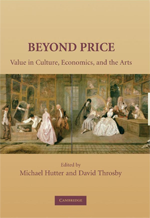
Beyond Price: Value in Culture, Economics, and the Arts; Edited by Michael Hutter and David Throsby; Cambridge University Press, 2007, 324 pages
The art that matters to us … is received by us as a gift is received. Even if we have paid a fee at the door of the museum or concert hall, when we are touched by a work of art something comes to us that has nothing to do with the price.
— Lewis Hyde
— Lewis Hyde
Before the house lights dim at a production of Romeo and Juliet, I look for myself and I am delighted to find myself as I was many years ago: A teenaged boy sitting by himself. I recognize him because he keeps checking the number on his ticket against the number on the armrest. All in all, he is pleased with his seat. He wears a sweater and tie. He reads his program with the intensity I used similarly to scrutinize the actors’ biographies, the director’s notes, and the advertisements for after-theater dining.
The current economic climate has forced many nonprofit arts organizations to confront underlying issues. Tensions mount, dollars are scarce, and unresolved weaknesses or fissures often grow. We have seen heartening examples of artists, donors, audiences, and funders rallying to support the art and organizations that they love. In some cases, streamlined, more focused organizations are forging ahead with renewed determination. But in other cases, the economic downturn may herald the time to close the doors.
In late January GIA polled its 309 member organizations about their organization's responses to the economic downturn. 117 (38%) members responded, which provides a healthy sample of the membership.
Members reported their expected 2009 arts grantmaking would likely compare to 2008 as follows:
- 41% expected that 2009 would be the same as 2008.
- 13% expected that it would be reduced to 90% of 2008.
- 12% expected that it would be reduced to 80% of 2008.
- 11% expected that it would be reduced to 70% of 2008.
Historical data do not mean anything in this situation. There is no blueprint and there is no network. We are doing the best we can with a combination of hard facts and intuition. Every line item is up for grabs; every $1,000 is material. How we feel about it all depends on which newspaper we read that morning.
Managing Director, large performing arts group
Introduction
Many of the feature articles in this issue offer tools for responding to GIA Executive Director Janet Brown's call to speak up, to not sit silently in the back but to stand up and illustrate or make the case for why arts and culture matters.
In the past two years, several prominent foundations at national, regional, and local levels have appointed new presidents. Such leadership transitions are likely to increase in the years ahead in keeping with the larger generational shift in the nonprofit sector. Very few of the new foundation leaders are likely to come from the arts sector, and many will have had little direct experience with our field.