
I am honored to have this opportunity to interview Gary Steuer, president and CEO of the Bonfils-Stanton Foundation. Gary is a respected colleague, a member of Grantmakers in the Arts’ board of directors, and co-chair of the GIA Denver Conference Planning Committee for the upcoming annual conference. I am pleased to note that Bonfils-Stanton has been embracing equity in their support of Denver’s nonprofit community, including its arts organizations.
Search
The GIA Library is an information hub that includes articles, research reports, and other materials covering a wide variety of topics relevant to the arts and arts funding. These resources are made available free to members and non-members of GIA. Users can search by keyword or browse by category for materials to use in research and self-directed learning. Current arts philanthropy news items are available separately in our news feed - News from the Field.
Having worked with panels since my first job in philanthropy at the National Endowment for the Arts, thirty years ago, I am always interested in learning more about how to make the panel system better. Discussions about process, scoring systems, panel adjudication methods, conflict of interest, panel recruitment, multistep review processes, criteria, and more are infinitely fascinating to me and at the heart of improving our own work at the Jerome Foundation.
Download:
 Arts Funding at Twenty-Five (318Kb)
Introduction
The easy convenience of typing a few key words into a search box and promptly being immersed in data can make one forget that this capability has existed for a remarkably short period of time. Just twenty-five years ago — a point in time well within the recollection of most members of the arts and culture sector — Stanley N. Katz, then president of the American Council of Learned Societies, observed, “the serious study of arts philanthropy is less than a generation old, and we are just beginning the sorts of data collection and analysis…we need to make sound judgments about the field.”1
In the wake of the worst global economic recession in living memory, the creative industries sector has emerged as a powerful engine for economic growth and social, environmental, and cultural sustainability. With growing concern over the staggering amounts of funding now being directed toward social impact initiatives globally and the effectiveness of those investments, perhaps the time has come for gatekeepers to consider adding the creative industries to the short list of investment-worthy target sectors.
The Jerome Foundation, St. Paul, Minnesota, and the Camargo Foundation, Cassis, France, are now operating under a single governance and integrated management structure.
Grantmakers in the Arts began work on capitalization in 2010. Ever since then we’ve debated not using the word “capitalization,” but it has prevailed. In our work, the term is synonymous with financial health and the resources needed to meet an organization’s mission. In 2010, GIA published recommendations for grantmakers regarding actions they could take that would improve the undercapitalized nature of the nonprofit arts sector.
As a writer who often ponders music and its many audiences, I spend a lot of time thinking about how some artists thrive, while others don’t, in places far from their first home. As listeners, members of an audience, we hear something that feels real, powerful, to us, and we feel connected to the experience of someone who may seem not much like us. From this experience we have a single urgent response: how can we share this with the world? You’ve got to hear this…
2007, 32 pages, www.tdavid.net
Because an intermediary organization (IO) is being asked to take on a function for a foundation, lines of power and authority can become blurred, especially in cases when an outside entity is making grants and convening key parties with the foundation’s dollars and under the foundation’s imprimatur. Tom David offers a series of best practices and outcomes based on interviews with over 50 foundations who have partnered with IOs:
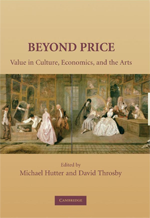
Beyond Price: Value in Culture, Economics, and the Arts; Edited by Michael Hutter and David Throsby; Cambridge University Press, 2007, 324 pages
The art that matters to us … is received by us as a gift is received. Even if we have paid a fee at the door of the museum or concert hall, when we are touched by a work of art something comes to us that has nothing to do with the price.
— Lewis Hyde
— Lewis Hyde