
Grantmakers in the Arts began work on capitalization in 2010. Ever since then we’ve debated not using the word “capitalization,” but it has prevailed. In our work, the term is synonymous with financial health and the resources needed to meet an organization’s mission. In 2010, GIA published recommendations for grantmakers regarding actions they could take that would improve the undercapitalized nature of the nonprofit arts sector.
Search
The GIA Library is an information hub that includes articles, research reports, and other materials covering a wide variety of topics relevant to the arts and arts funding. These resources are made available free to members and non-members of GIA. Users can search by keyword or browse by category for materials to use in research and self-directed learning. Current arts philanthropy news items are available separately in our news feed - News from the Field.
Immediately following Hurricane Sandy, the Andy Warhol, Lambent, and Robert Rauschenberg Foundations (“the primary funders”) approached the New York Foundation for the Arts to administer a fund to provide grants to individual artists in all disciplines from Connecticut, New Jersey, and New York. In addition to the substantial and catalytic support from the three foundations, NYFA also raised additional funds for this project through further donations from our generous individual and institutional supporters and collaborators.
“As this has never been done before, we have no idea what we’re doing today,” Joanna Haigood half-joked at the launch of Paseo, less a walking tour than a movable, danceable feast, a peripatetic block party that, for one delightful hour, would twist through the South Bronx neighborhoods of Hunts Point and Longwood.
About four years ago I attended an extraordinary meeting in Philadelphia. Susan Nelson, principal of Technical Development Corporation (TDC), was presenting the draft of Getting Beyond Breakeven to the Greater Philadelphia Cultural Alliance and many other stakeholders associated with the work.
Enriching our culture and engaging diverse and underserved communities, small arts organizations pop up, flourish, and sometimes flounder, mostly under the philanthropic radar. They often foster artistic expressions not adequately served by larger organizations.
2007, 32 pages, www.tdavid.net
Because an intermediary organization (IO) is being asked to take on a function for a foundation, lines of power and authority can become blurred, especially in cases when an outside entity is making grants and convening key parties with the foundation’s dollars and under the foundation’s imprimatur. Tom David offers a series of best practices and outcomes based on interviews with over 50 foundations who have partnered with IOs:
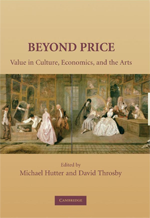
Beyond Price: Value in Culture, Economics, and the Arts; Edited by Michael Hutter and David Throsby; Cambridge University Press, 2007, 324 pages
The art that matters to us … is received by us as a gift is received. Even if we have paid a fee at the door of the museum or concert hall, when we are touched by a work of art something comes to us that has nothing to do with the price.
— Lewis Hyde
— Lewis Hyde
When I was in college, I had a great work-study job at an organization that placed students in internships with local nonprofits. It was a small outfit and a jack-of-all-trades sort of job. I answered phones, mocked up application forms, stuffed envelopes, filed, ran errands, organized open houses, and learned how to write a business letter. It wasn’t the sort of job you’d want to stay in for too long, but it was a fabulous introduction to the nonprofit sector. It gave me practical office skills to boot.
How are artists weathering the economic downturn? Artist Trust wanted to take the pulse of the Washington State artist community and to consider what programmatic solutions Artist Trust and others might offer. Between March 15 and April 15, 2009 nearly 700 artists responded to an online survey. The survey was not designed to collect data for quantitative analysis; rather, it was conducted as a way to gain an informal snapshot of artists’ personal situations.