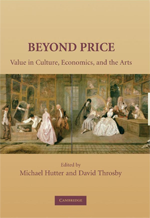
Beyond Price: Value in Culture, Economics, and the Arts; Edited by Michael Hutter and David Throsby; Cambridge University Press, 2007, 324 pages
— Lewis Hyde
Contact GIAGIA Reader PublicationBecome A GIA Member
450 Lexington Ave, Unit 4501 | New York, NY | gia@giarts.org
The GIA Library is an information hub that includes articles, research reports, and other materials covering a wide variety of topics relevant to the arts and arts funding. These resources are made available free to members and non-members of GIA. Users can search by keyword or browse by category for materials to use in research and self-directed learning. Current arts philanthropy news items are available separately in our news feed - News from the Field.

Beyond Price: Value in Culture, Economics, and the Arts; Edited by Michael Hutter and David Throsby; Cambridge University Press, 2007, 324 pages
Many of the feature articles in this issue offer tools for responding to GIA Executive Director Janet Brown's call to speak up, to not sit silently in the back but to stand up and illustrate or make the case for why arts and culture matters.
Typically when businesses decide to support the arts they do so through a grant-giving mechanism or through a program that places employees as volunteers and consultants in arts organizations. But, I've noticed a different kind of interaction between the profit-making and not-for-profit art worlds in recent years. Some business people have set up foundations dedicated to improving the ethical and cultural context in which their own professions practice.
We live in a world of "widespread hostility toward the United States and its policies."1 This antipathy is not limited to the countries and peoples that are directly affected by the U.S. "war on terror" and its attendant pol-icies, but includes many of our former allies and fellow democracies. A friend who just returned from a year in Spain reports that she spent a significant amount of time and energy convincing people she met there that the U.S.
A labor of love for individuals committed to the significance and potential of media, Why FUND Media is a timely and worthy follow-up to a 1984 publication by the Council on Foundations titled How to Fund Media. Editor Karen Hirsch seamlessly brings together a series of separate chapters written by media arts experts who've based their chapter essays on extensive consultations with field representatives and grantmakers, and on historical research.