
Every decade or two, the professions of architecture and city planning are captivated by a movement with a particularly catchy name. Currently, the popular term is placemaking — a fairly loose term that is running neck and neck with “sustainability.” Within the design professions, this movement — really more a philosophy — suggests that people’s lives can be made better by intentionally designing interior and exterior spaces to embrace a wide range of users, provide for safety, and create artful expressions that endure over time.
Search
The GIA Library is an information hub that includes articles, research reports, and other materials covering a wide variety of topics relevant to the arts and arts funding. These resources are made available free to members and non-members of GIA. Users can search by keyword or browse by category for materials to use in research and self-directed learning. Current arts philanthropy news items are available separately in our news feed - News from the Field.
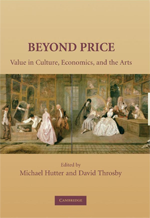
Beyond Price: Value in Culture, Economics, and the Arts; Edited by Michael Hutter and David Throsby; Cambridge University Press, 2007, 324 pages
The art that matters to us … is received by us as a gift is received. Even if we have paid a fee at the door of the museum or concert hall, when we are touched by a work of art something comes to us that has nothing to do with the price.
— Lewis Hyde
— Lewis Hyde
Historical data do not mean anything in this situation. There is no blueprint and there is no network. We are doing the best we can with a combination of hard facts and intuition. Every line item is up for grabs; every $1,000 is material. How we feel about it all depends on which newspaper we read that morning.
Managing Director, large performing arts group
Introduction
The following piece is excerpted from the second of a two-part article written for the Community Arts Network, “The New New Deal.” Part one, published in December 2008, was titled, “the New New Deal: Public Service Jobs for Artists.” It described some of the things artists could do with public-service jobs. This excerpt is from part two, published February 24, 2009, “A New WPA for Artists: How and Why.” In this excerpt, Goldbard takes up the question of “why,” what are all the good reasons to support a new WPA for artists.
Arts and education grantmakers at an historic gathering in Santa Fe in October of 2007 agreed on the need to forge a new vision for public education in the United States and to collectively explore how the arts can help shape and realize that vision.
Convened by Grantmakers in the Arts and Grantmakers for Education, more than 100 foundation representatives met formally for the first time under the aegis of their two affinity organizations to debate and discuss the role of the arts in education.
As conference co-chairs, neither of whom has lived in New Mexico, we were told that the story of art in New Mexico is a story of place, that the regionits landscape, its convergence of cultures, its sacred spacesdefines what and how art is made. We turned to a number of New Mexico artists and writers to give us their inside views of this remarkable region. Among them is Chrissie Orr, a transplant from Scotland, who makes work informed and formed by New Mexico's physical environment.
"I believe that if we can keep our values close, our imaginations open, and our stories fierce, we can and will win." - Thenmozhi Soundararajan
Introduction
Beginning in 1999, the United Nations Educational, Scientific and Cultural Organization (UNESCO) launched a global initiative to strengthen arts education. In 2003, Portuguese delegates to the United Nations called for a global conference to address this aim, resulting in the first-ever World Conference on Arts Education. The World Conference brought together 1,200 artists, educators, policy makers, and researchers from over ninety-seven countries in Lisbon, Portugal from March 6-9, 2006.
2006, 114 pages. Published by the University of Minnesota, Humphrey Institute of Public Affairs, Project on Regional and Industrial Economics (PRIE). Funded by the McKnight Foundation and the Fesler-Lampert Chair in Urban and Regional Affairs, University of Minnesota.
We live in a world of "widespread hostility toward the United States and its policies."1 This antipathy is not limited to the countries and peoples that are directly affected by the U.S. "war on terror" and its attendant pol-icies, but includes many of our former allies and fellow democracies. A friend who just returned from a year in Spain reports that she spent a significant amount of time and energy convincing people she met there that the U.S.