
About four years ago I attended an extraordinary meeting in Philadelphia. Susan Nelson, principal of Technical Development Corporation (TDC), was presenting the draft of Getting Beyond Breakeven to the Greater Philadelphia Cultural Alliance and many other stakeholders associated with the work.
Search
The GIA Library is an information hub that includes articles, research reports, and other materials covering a wide variety of topics relevant to the arts and arts funding. These resources are made available free to members and non-members of GIA. Users can search by keyword or browse by category for materials to use in research and self-directed learning. Current arts philanthropy news items are available separately in our news feed - News from the Field.
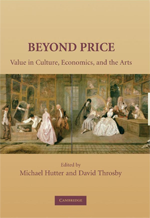
Beyond Price: Value in Culture, Economics, and the Arts; Edited by Michael Hutter and David Throsby; Cambridge University Press, 2007, 324 pages
The art that matters to us … is received by us as a gift is received. Even if we have paid a fee at the door of the museum or concert hall, when we are touched by a work of art something comes to us that has nothing to do with the price.
— Lewis Hyde
— Lewis Hyde
How are artists weathering the economic downturn? Artist Trust wanted to take the pulse of the Washington State artist community and to consider what programmatic solutions Artist Trust and others might offer. Between March 15 and April 15, 2009 nearly 700 artists responded to an online survey. The survey was not designed to collect data for quantitative analysis; rather, it was conducted as a way to gain an informal snapshot of artists’ personal situations.
Remix: Making Art and Commerce Thrive in the Hybrid Economy
Penguin Press, 2008, 352 pages. ISBN-10: 1594201722
In late January GIA polled its 309 member organizations about their organization's responses to the economic downturn. 117 (38%) members responded, which provides a healthy sample of the membership.
Members reported their expected 2009 arts grantmaking would likely compare to 2008 as follows:
- 41% expected that 2009 would be the same as 2008.
- 13% expected that it would be reduced to 90% of 2008.
- 12% expected that it would be reduced to 80% of 2008.
- 11% expected that it would be reduced to 70% of 2008.
Historical data do not mean anything in this situation. There is no blueprint and there is no network. We are doing the best we can with a combination of hard facts and intuition. Every line item is up for grabs; every $1,000 is material. How we feel about it all depends on which newspaper we read that morning.
Managing Director, large performing arts group
Introduction
Many of the feature articles in this issue offer tools for responding to GIA Executive Director Janet Brown's call to speak up, to not sit silently in the back but to stand up and illustrate or make the case for why arts and culture matters.
In The Place of the Arts in Multi-focus Foundations, Bruce Sievers writes that the rationale for supporting both the arts and the nonprofit sector as a whole is integrally linked to their capacity to advance pluralism, promote voluntary action, accommodate diversity, and champion individual visions of the public good. “Civil society,” Sievers notes, is increasingly the accepted concept to describe this sphere of social action.
The following piece is excerpted from the second of a two-part article written for the Community Arts Network, “The New New Deal.” Part one, published in December 2008, was titled, “the New New Deal: Public Service Jobs for Artists.” It described some of the things artists could do with public-service jobs. This excerpt is from part two, published February 24, 2009, “A New WPA for Artists: How and Why.” In this excerpt, Goldbard takes up the question of “why,” what are all the good reasons to support a new WPA for artists.
Between 2006 and 2008, the Social Impact of the Arts Project, a research group at the University of Pennsylvania (SIAP), collaborated with The Reinvestment Fund (TRF), a community development financial institution, on an investigation of the creative sector's potential contribution to neighborhood economic and community development.