
Adults age sixty-five and above are currently the fastest-growing segment of the US population. In 2016, there were 47.8 million individuals age sixty-five and over in the United States (US Census Bureau 2017), and this number is expected to more than double by 2060. By 2040, nearly half of older adults are expected to come from diverse racial/ethnic and socioeconomic backgrounds (Vincent and Velkoff 2010; Johnson, Rodriquez-Salazar, et al. 2018). San Francisco’s population of older adults is higher than the national norm.
Search
The GIA Library is an information hub that includes articles, research reports, and other materials covering a wide variety of topics relevant to the arts and arts funding. These resources are made available free to members and non-members of GIA. Users can search by keyword or browse by category for materials to use in research and self-directed learning. Current arts philanthropy news items are available separately in our news feed - News from the Field.
About four years ago I attended an extraordinary meeting in Philadelphia. Susan Nelson, principal of Technical Development Corporation (TDC), was presenting the draft of Getting Beyond Breakeven to the Greater Philadelphia Cultural Alliance and many other stakeholders associated with the work.
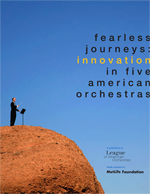
Fearless Journeys: Innovation in Five American Orchestras is the report of a 2009 study, funded by MetLife Foundation, which explored and documented five examples of promising innovative practices in American orchestras. This is the first formal attempt to define and to understand the organizational factors that support innovation in orchestras.
In the past two years, several prominent foundations at national, regional, and local levels have appointed new presidents. Such leadership transitions are likely to increase in the years ahead in keeping with the larger generational shift in the nonprofit sector. Very few of the new foundation leaders are likely to come from the arts sector, and many will have had little direct experience with our field.
The following piece is excerpted from the second of a two-part article written for the Community Arts Network, “The New New Deal.” Part one, published in December 2008, was titled, “the New New Deal: Public Service Jobs for Artists.” It described some of the things artists could do with public-service jobs. This excerpt is from part two, published February 24, 2009, “A New WPA for Artists: How and Why.” In this excerpt, Goldbard takes up the question of “why,” what are all the good reasons to support a new WPA for artists.
Between 2006 and 2008, the Social Impact of the Arts Project, a research group at the University of Pennsylvania (SIAP), collaborated with The Reinvestment Fund (TRF), a community development financial institution, on an investigation of the creative sector's potential contribution to neighborhood economic and community development.
As conference co-chairs, neither of whom has lived in New Mexico, we were told that the story of art in New Mexico is a story of place, that the regionits landscape, its convergence of cultures, its sacred spacesdefines what and how art is made. We turned to a number of New Mexico artists and writers to give us their inside views of this remarkable region. Among them is Chrissie Orr, a transplant from Scotland, who makes work informed and formed by New Mexico's physical environment.
Classical musics are comparatively rare; they seem to need for their existence not only a leisured class able to command a quantity of surplus resources but also a situation where that class is to some degree isolated from the majority of the people and possesses the social power to represent its own tastes as superior.
"I believe that if we can keep our values close, our imaginations open, and our stories fierce, we can and will win." - Thenmozhi Soundararajan
Introduction
America is on the threshold of a significant transformation in cultural life. There have been many cultural shifts in recorded history: Gutenberg's invention of the printing press and the rise of the reading public; the growth of a mercantile class and the birth of private art markets independent of the church and the king; the invention of gas streetlights and the beginning of urban nighttime entertainment. The most recent cultural transformation, still with us today, was set in motion on the threshold of the twentieth century.