
In many ways, it has been a heartening year for champions of the literary arts.
Search
The GIA Library is an information hub that includes articles, research reports, and other materials covering a wide variety of topics relevant to the arts and arts funding. These resources are made available free to members and non-members of GIA. Users can search by keyword or browse by category for materials to use in research and self-directed learning. Current arts philanthropy news items are available separately in our news feed - News from the Field.
During the 1960s, a progressive liberation of the spectator from observer to active participant occurred in the visual and performing arts, which were reciprocally informed by participatory forms of social protest and performance: marches, sit-ins, riots, and so on. Dancer and choreographer Anna Halprin (née Ann Schuman, 1920–), with her San Francisco Dancers’ Workshop, was directly involved in these developments, and their experiments soon infiltrated the creative endeavors of her husband, landscape architect Lawrence Halprin (1916–2009).
Writing is a solitary pursuit, and writers are often depicted as hermit-like figures. Rural writers, however, unlike their more urban counterparts, face an additional kind of isolation: they have few opportunities to rub shoulders with other writers and few, if any, chances to attend readings. For young writers, the isolation is particularly acute. Role models are absent, and even the idea of being a writer can be so foreign as to never enter their heads.
Placing the cause and calling of literature ahead of the bottom line, independent literary publishers serve as a primary link between writers — particularly those representing emerging voices, culturally specific communities, and literary art forms not fostered by mainstream publishers — and readers. Independent literary publications create an enduring record of cultural activity and provide an essential alternative to the voices heard through large-scale, commercial publishing.
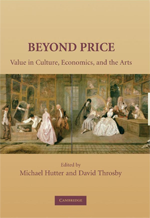
Beyond Price: Value in Culture, Economics, and the Arts; Edited by Michael Hutter and David Throsby; Cambridge University Press, 2007, 324 pages
The art that matters to us … is received by us as a gift is received. Even if we have paid a fee at the door of the museum or concert hall, when we are touched by a work of art something comes to us that has nothing to do with the price.
— Lewis Hyde
— Lewis Hyde
Before the house lights dim at a production of Romeo and Juliet, I look for myself and I am delighted to find myself as I was many years ago: A teenaged boy sitting by himself. I recognize him because he keeps checking the number on his ticket against the number on the armrest. All in all, he is pleased with his seat. He wears a sweater and tie. He reads his program with the intensity I used similarly to scrutinize the actors’ biographies, the director’s notes, and the advertisements for after-theater dining.
The current economic climate has forced many nonprofit arts organizations to confront underlying issues. Tensions mount, dollars are scarce, and unresolved weaknesses or fissures often grow. We have seen heartening examples of artists, donors, audiences, and funders rallying to support the art and organizations that they love. In some cases, streamlined, more focused organizations are forging ahead with renewed determination. But in other cases, the economic downturn may herald the time to close the doors.
How are artists weathering the economic downturn? Artist Trust wanted to take the pulse of the Washington State artist community and to consider what programmatic solutions Artist Trust and others might offer. Between March 15 and April 15, 2009 nearly 700 artists responded to an online survey. The survey was not designed to collect data for quantitative analysis; rather, it was conducted as a way to gain an informal snapshot of artists’ personal situations.
In late January GIA polled its 309 member organizations about their organization's responses to the economic downturn. 117 (38%) members responded, which provides a healthy sample of the membership.
Members reported their expected 2009 arts grantmaking would likely compare to 2008 as follows:
- 41% expected that 2009 would be the same as 2008.
- 13% expected that it would be reduced to 90% of 2008.
- 12% expected that it would be reduced to 80% of 2008.
- 11% expected that it would be reduced to 70% of 2008.
Historical data do not mean anything in this situation. There is no blueprint and there is no network. We are doing the best we can with a combination of hard facts and intuition. Every line item is up for grabs; every $1,000 is material. How we feel about it all depends on which newspaper we read that morning.
Managing Director, large performing arts group
Introduction