
It’s Friday night. A Netflix subscriber is sitting on their couch, scrolling through an endless feed of entertainment options. They pass by the next episode of Stranger Things, skip over the Marvel movies, shrug at Friday Night Lights. Finally, they land on the latest environmental documentary film release. They grab their blanket and popcorn and eagerly press play.
Search
The GIA Library is an information hub that includes articles, research reports, and other materials covering a wide variety of topics relevant to the arts and arts funding. These resources are made available free to members and non-members of GIA. Users can search by keyword or browse by category for materials to use in research and self-directed learning. Current arts philanthropy news items are available separately in our news feed - News from the Field.
Art is not magic; most artists are not all that different from other people. However, many of them developed a skill or asset that most of us haven’t: a fascination for the undercurrent in our society, in our social encounters, in our practices, in our organizations.
Jaap Warmenhoven, Stanford Social Innovation Review

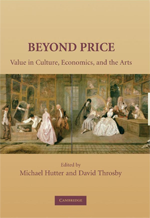
Beyond Price: Value in Culture, Economics, and the Arts; Edited by Michael Hutter and David Throsby; Cambridge University Press, 2007, 324 pages
The art that matters to us … is received by us as a gift is received. Even if we have paid a fee at the door of the museum or concert hall, when we are touched by a work of art something comes to us that has nothing to do with the price.
— Lewis Hyde
— Lewis Hyde
Before the house lights dim at a production of Romeo and Juliet, I look for myself and I am delighted to find myself as I was many years ago: A teenaged boy sitting by himself. I recognize him because he keeps checking the number on his ticket against the number on the armrest. All in all, he is pleased with his seat. He wears a sweater and tie. He reads his program with the intensity I used similarly to scrutinize the actors’ biographies, the director’s notes, and the advertisements for after-theater dining.
The current economic climate has forced many nonprofit arts organizations to confront underlying issues. Tensions mount, dollars are scarce, and unresolved weaknesses or fissures often grow. We have seen heartening examples of artists, donors, audiences, and funders rallying to support the art and organizations that they love. In some cases, streamlined, more focused organizations are forging ahead with renewed determination. But in other cases, the economic downturn may herald the time to close the doors.
How are artists weathering the economic downturn? Artist Trust wanted to take the pulse of the Washington State artist community and to consider what programmatic solutions Artist Trust and others might offer. Between March 15 and April 15, 2009 nearly 700 artists responded to an online survey. The survey was not designed to collect data for quantitative analysis; rather, it was conducted as a way to gain an informal snapshot of artists’ personal situations.
Remix: Making Art and Commerce Thrive in the Hybrid Economy
Penguin Press, 2008, 352 pages. ISBN-10: 1594201722
In late January GIA polled its 309 member organizations about their organization's responses to the economic downturn. 117 (38%) members responded, which provides a healthy sample of the membership.
Members reported their expected 2009 arts grantmaking would likely compare to 2008 as follows:
- 41% expected that 2009 would be the same as 2008.
- 13% expected that it would be reduced to 90% of 2008.
- 12% expected that it would be reduced to 80% of 2008.
- 11% expected that it would be reduced to 70% of 2008.
Ralph Smith, the 2007 Conference Chairman, issued a challenge in his welcome message – “that all who attend will leave with renewed energy, capacity and resolve to make a positive contribution toward meeting the challenges of our time.”