
Despite New York City’s status as the dance capital of the United States, rising real estate prices are challenging the city’s ability to serve as a creative incubator, with space — an essential resource for making dance — in waning supply. Choreographers and dancers need to work in a large open area with a sprung floor, but as real estate values climb, long-standing dance studios are being bought by developers and converted into residential or commercial spaces.
Search
The GIA Library is an information hub that includes articles, research reports, and other materials covering a wide variety of topics relevant to the arts and arts funding. These resources are made available free to members and non-members of GIA. Users can search by keyword or browse by category for materials to use in research and self-directed learning. Current arts philanthropy news items are available separately in our news feed - News from the Field.
“As this has never been done before, we have no idea what we’re doing today,” Joanna Haigood half-joked at the launch of Paseo, less a walking tour than a movable, danceable feast, a peripatetic block party that, for one delightful hour, would twist through the South Bronx neighborhoods of Hunts Point and Longwood.
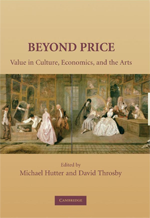
Beyond Price: Value in Culture, Economics, and the Arts; Edited by Michael Hutter and David Throsby; Cambridge University Press, 2007, 324 pages
The art that matters to us … is received by us as a gift is received. Even if we have paid a fee at the door of the museum or concert hall, when we are touched by a work of art something comes to us that has nothing to do with the price.
— Lewis Hyde
— Lewis Hyde
How are artists weathering the economic downturn? Artist Trust wanted to take the pulse of the Washington State artist community and to consider what programmatic solutions Artist Trust and others might offer. Between March 15 and April 15, 2009 nearly 700 artists responded to an online survey. The survey was not designed to collect data for quantitative analysis; rather, it was conducted as a way to gain an informal snapshot of artists’ personal situations.
In late January GIA polled its 309 member organizations about their organization's responses to the economic downturn. 117 (38%) members responded, which provides a healthy sample of the membership.
Members reported their expected 2009 arts grantmaking would likely compare to 2008 as follows:
- 41% expected that 2009 would be the same as 2008.
- 13% expected that it would be reduced to 90% of 2008.
- 12% expected that it would be reduced to 80% of 2008.
- 11% expected that it would be reduced to 70% of 2008.
Historical data do not mean anything in this situation. There is no blueprint and there is no network. We are doing the best we can with a combination of hard facts and intuition. Every line item is up for grabs; every $1,000 is material. How we feel about it all depends on which newspaper we read that morning.
Managing Director, large performing arts group
Introduction
Many of the feature articles in this issue offer tools for responding to GIA Executive Director Janet Brown's call to speak up, to not sit silently in the back but to stand up and illustrate or make the case for why arts and culture matters.
In the past two years, several prominent foundations at national, regional, and local levels have appointed new presidents. Such leadership transitions are likely to increase in the years ahead in keeping with the larger generational shift in the nonprofit sector. Very few of the new foundation leaders are likely to come from the arts sector, and many will have had little direct experience with our field.
In The Place of the Arts in Multi-focus Foundations, Bruce Sievers writes that the rationale for supporting both the arts and the nonprofit sector as a whole is integrally linked to their capacity to advance pluralism, promote voluntary action, accommodate diversity, and champion individual visions of the public good. “Civil society,” Sievers notes, is increasingly the accepted concept to describe this sphere of social action.
Between 2006 and 2008, the Social Impact of the Arts Project, a research group at the University of Pennsylvania (SIAP), collaborated with The Reinvestment Fund (TRF), a community development financial institution, on an investigation of the creative sector's potential contribution to neighborhood economic and community development.